Boris Caesar Wilhelm Hagelin's Cipher Machines
Model B211
This device used a keyboard to enter text and a lamp board to display the
result. To encipher a letter, is it first fractionated using the square
given below.
|
L
|
N
|
R
|
S
|
T
|
|
A
|
L
|
M
|
Y
|
F
|
X
|
|
E
|
O
|
J
|
B
|
R
|
S
|
|
I
|
P
|
U
|
G
|
C
|
W
|
|
O
|
K
|
N
|
T
|
D
|
Q
|
|
U
|
I
|
H
|
V
|
E
|
A
|
Then each component is separately enciphered using two half rotors
- electric switching devices. A half rotor has five input contact rings
and ten output points. Five (every second) output points contacts an end-plate.
Depending on the position of the half rotor, each input contact is connected
to one contact on the end-plate. Thus each rotor selects one of ten permutations
for connecting five inputs to five outputs. The resulting permutations
are given in the table below. The first line contains the input contacts
of the half rotors, the following lines show the arising permutations.
|
Rotor I
|
A
|
E
|
I
|
O
|
U
|
|
|
Rotor II
|
L
|
N
|
R
|
S
|
T
|
|
A
|
A
|
E
|
I
|
U
|
O
|
|
|
A
|
R
|
S
|
N
|
L
|
T
|
|
B
|
O
|
I
|
U
|
E
|
A
|
|
|
B
|
S
|
T
|
R
|
N
|
L
|
|
C
|
E
|
I
|
O
|
A
|
U
|
|
|
C
|
N
|
R
|
L
|
T
|
S
|
|
D
|
U
|
O
|
A
|
I
|
E
|
|
|
D
|
R
|
S
|
N
|
T
|
L
|
|
E
|
I
|
O
|
U
|
E
|
A
|
|
|
E
|
L
|
N
|
T
|
S
|
R
|
|
F
|
A
|
U
|
E
|
O
|
I
|
|
|
F
|
N
|
R
|
L
|
S
|
T
|
|
G
|
O
|
U
|
A
|
I
|
E
|
|
|
G
|
T
|
L
|
S
|
R
|
N
|
|
H
|
E
|
A
|
I
|
U
|
O
|
|
|
H
|
L
|
N
|
T
|
R
|
S
|
|
I
|
U
|
A
|
E
|
O
|
I
|
|
|
I
|
S
|
T
|
R
|
N
|
L
|
|
K
|
I
|
E
|
O
|
A
|
U
|
|
|
K
|
T
|
L
|
S
|
N
|
R
|
The stepping of the half rotors is controlled by variable pin wheels:
Such a disc has a number of pins at it's circumference which may be placed
in an active or passive position. In the B211, the wheels have 23, 21,
19, and 17 pins. Rotor I steps before enciphering whenever at
least one of the 23 and 21 pin wheel have an active pin in the proper position.
Rotor II is controlled by the 19 and 17 pin wheel in the same
manner. All pin wheels perform one step for each character processed.
Finally, a plug board is used to connect the endplate to the lamp board
which recombines the two component using square given above.
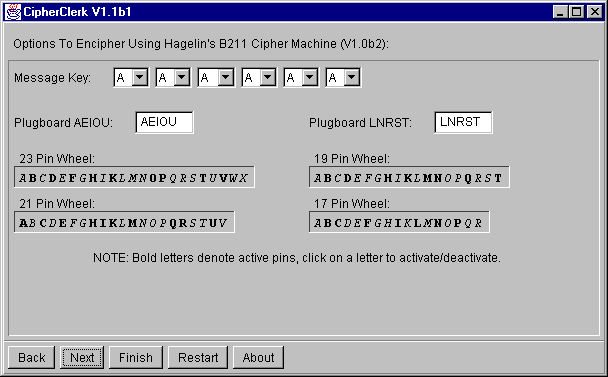
To encipher, you have to select an initial positions for the two half
rotors and four pinwheels. CipherClerk's Applet offers a choice for each wheel's
initial position. The choices denote - left to right beneath the Message
Key label: Rotor I, Rotor II, flowed by the pin wheels 23, 21, 19,
and 17.
To specify the plug boards just enter the letters in any order. To change
a pinwheel, click on a letter to toggle it's state: Bold letters indicate
an active pin, italic letters indicate inactive pins.
NOTE: For the real machine, when the apparent setting of the pin wheels
was AAAA, the effective setting was GFHG, e.g. when you
set the 23 pin wheel to position A, the pin at position G
is the effects the stepping of the half rotor. At
present, CipherClerk's Applet doesn't mimics this. If you set an active pin
at position A it will effects the stepping of the half rotor when
the according wheel is in position A! However, this
may change in future versions.
Model C-35
This machine uses a Beaufort encryption scheme. Five pin wheels (as described
above) are used to generate a long, non-repeating key. These pinwheels
have 25, 23, 21, 19, and 17 pins. When having an active pin in the effective
position, the pin wheels generate an offset of 10, 8, 4, 2, and 1. The
offsets of all five wheels are added to obtain a total offset.
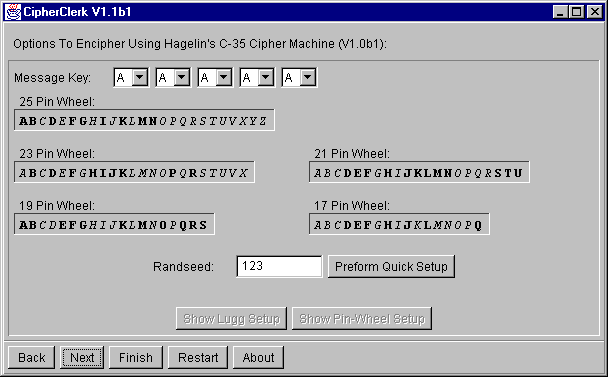
To encipher you must set the initial positions of the pin wheels and
set up the positions of the active pins. CipherClerk's Applet offers to generate
such a pin setup at random: enter a number in the flied labeled Randseed
and press the Perform Quick Setup button
Model C-38
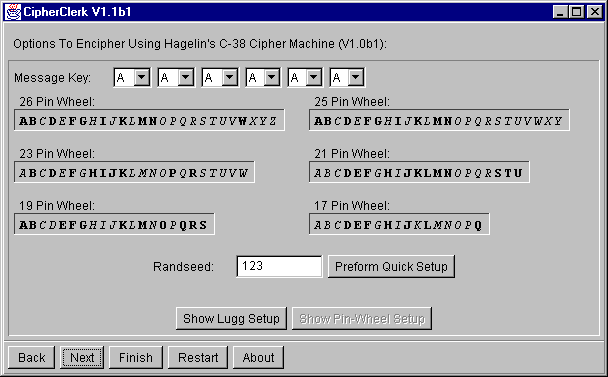
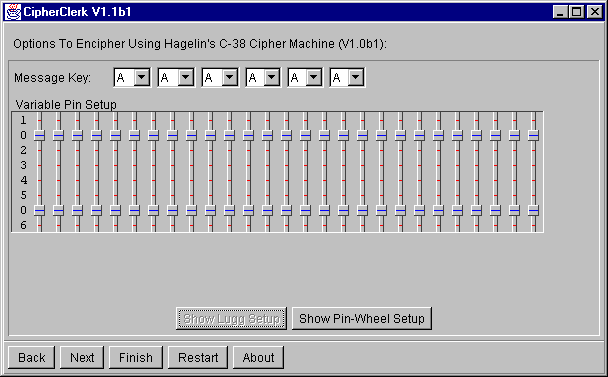
This machine differs from the C-35 only in the way the offsets are generated
....
To proceed, you may